Endearingly interested

Cabinet photo. Private Collection.

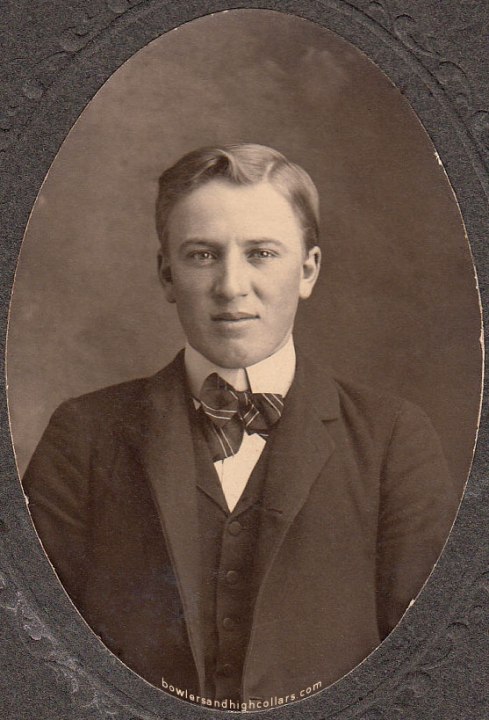
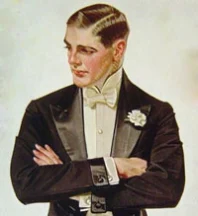
An endearing expression. Cabinet photo circa 1900. Private Collection.

This young man’s expression is so cute, cute, cute. And his bowtie is crooked. He wants to smile, yet he looks like he’s checking out something or is interested in the process.

This picture portrait came out wonderfully, didn’t it?

No name or photographer logo.

Creative Commons License


Think of me when I’m gone

1920s Belgian postcard. Private Collection.

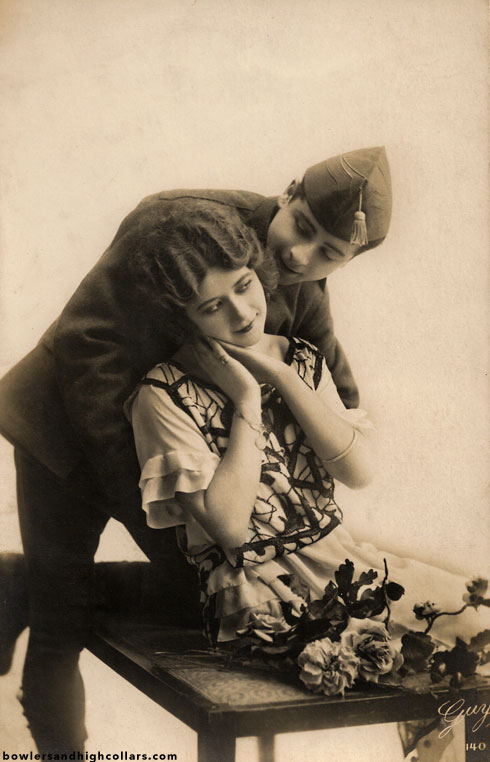
1920s Guy Belgian postcard. Private Collection.

This one was posted November 10 1926. A beautiful sepia postcard of the era showing a soldier whispering to his sweetheart.

Creative Commons License
Digital restoration work titled Think Of Me When I’m Gone by Caroline C. Ryan is licensed under a Creative Commons Attribution-NonCommercial-NoDerivatives 4.0 International License.


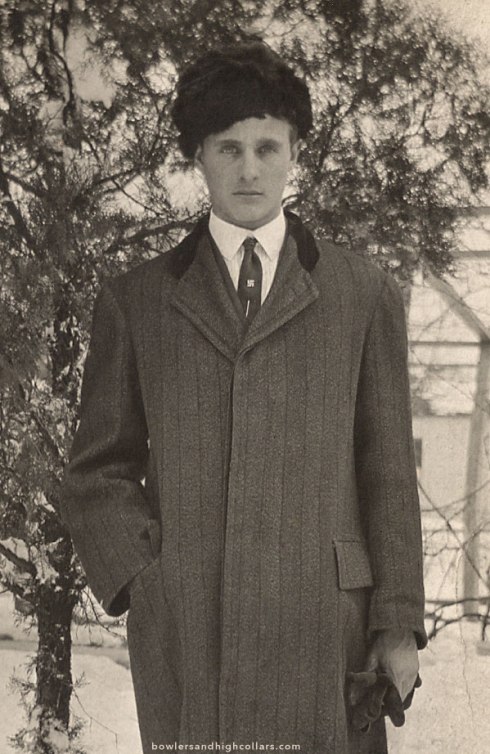
1912 15 years old Raymond and a good luck charm later tarnished by Hitler

Detail of RPPC

Detail of RPPC. Private Collection.

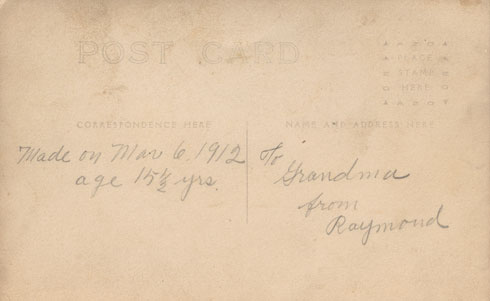
I thought him older but the note on the back of this RPPC reveals he was 15 and a half at the time the picture was taken. Must be the classic menswear and the serious expression.

He’s wearing a coat that still would be stylish today. On his head a russian style fur hat and yes, this is a swastika tie pin on him. I like pictures that prompt me to do research.  This pre-dates by two decades Hitler’s defamation of the symbol. The swastika bears so many meanings and was used in surprising ways.

Looking at the style of house behind him the boy was American, and this is not common knowledge, but apart from being an ancient Hindu symbol of good luck, the swastika has U.S. roots too.

The Navajo tribe used it (how they came about to using it would be interesting to find out too), and the 45th American National Guard infantry unit adopted the symbol in the 1910s as a tribute to Native Americans. That’s right, they wore a swastika as their patch, at least until Hitler unfortunately adopted it in the 30s. They then replaced it with a Thunderbird. Also, aviators used to pin it on as a lucky charm.

Why Raymond wore it? For the same reason mentioned: a good luck charm.
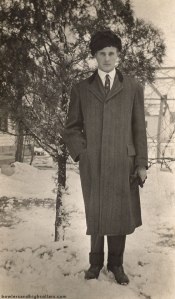
Raymond in the snow. RPPC. Private collection.

Raymond in the snow. RPPC. Private collection.

With a sweet note to his grandma

To his grandmother -aw.

Raymond may look all grown up on this picture, but when you still count your age in half years…!

RPPC: AZO 1904-1918


Photobooth in a white hat

Photobooth picture of man in white hat.

Photobooth picture of man in white hat. Private Collection.

A cute Photobooth snapshot of a bright eyed guy (with that twinkle again lol) leaning forward and smiling under his heavily tilted white hat. I think this picture was taken in the 40s or 50s just because of his open shirt.


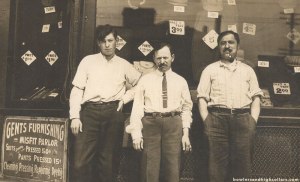
1900s Gents Furnishing & Misfit Parlor

Gents Furnishing storefront. RPPC. Private Collection.

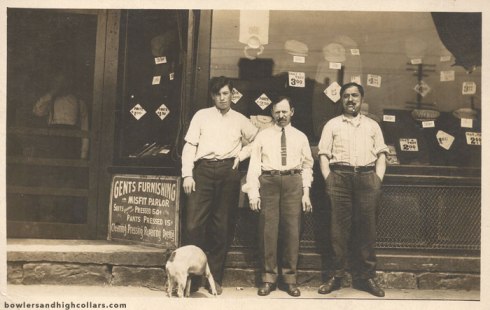
Gents Furnishing & Misfit Parlor storefront. RPPC. Private Collection.

I love this very quaint and informative picture. And there is another employee looking out from behind the shop’s door; too shy to get in the picture? This looks like it may have been a family business. Most caps in this shop were .39c. Some suits are priced at $4, some cheaper. At the time the median daily wages for average skilled workers was between $1.50 and 3 dollars a day, so it gives you an idea of how expensive clothes were. There were no cheaper options like we have today. After rent, clothes took the largest chunk out of people’s earnings, with food (and tobacco and drinks *cough*).

This shop sold menswear but also cleaned and pressed. I find it humorous they called it the Misfit Parlor. The younger gent to the left with a dog at his feet (probably theirs) is looking a bit bored.

Detail.

Detail.

Another storefront group RPPC in this collection, this time of tailors.