
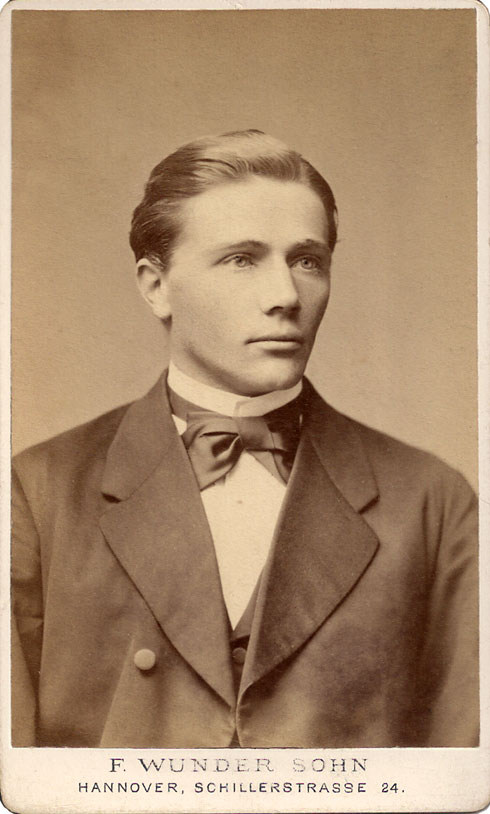
Hannover CDV. Private Collection.
The round edge card’s back is mint green with simple lettering, dating it to around the 1880s most likely. The wide lapels look 1870-ish to me.
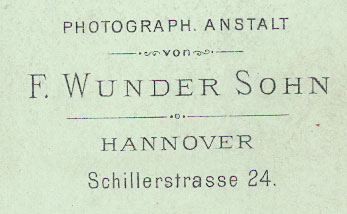
F. Wunder Sohn. Hannover.
Hannover CDV. Private Collection.
The round edge card’s back is mint green with simple lettering, dating it to around the 1880s most likely. The wide lapels look 1870-ish to me.
F. Wunder Sohn. Hannover.
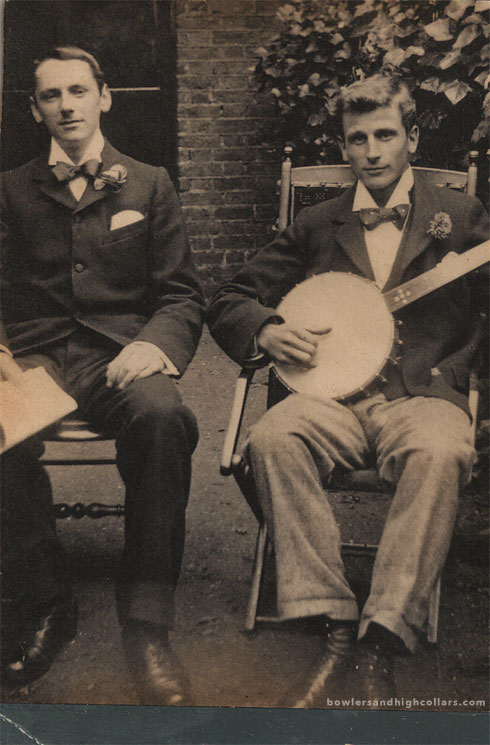
Banjo player and friend. CDV. Private Collection.
They have boutonniere flowers on the lapels. This was taken at a formal event sometime in the 1890s or 1900s, maybe at a wedding.
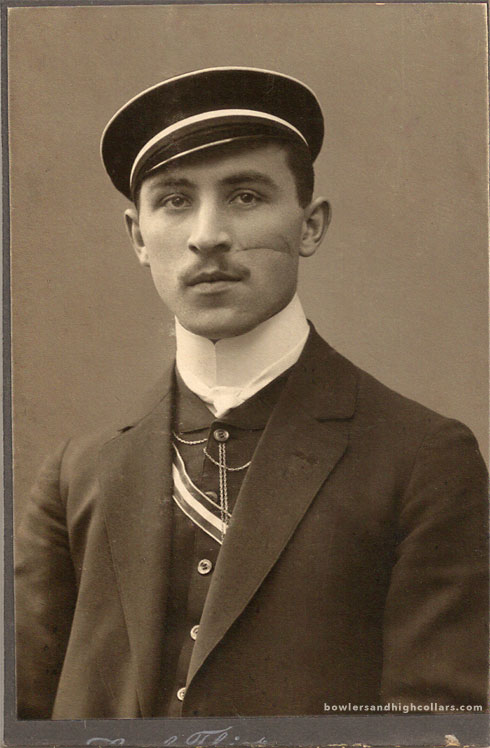
Scarred cheek German man. CDV. Private Collection.
This German man may have been a veteran soldier in civilian suit. Something got him good on the side of the face, perhaps a knife. I’m thinking he was a soldier for the ribbon across the chest. He’s also wearing the black visor hat I mentioned before that was so popular in Germany at the time, and both worn by boys and men.
The bottom of the card was clipped to fit into an album. I can’t make out the message or handwritten name, only the year: 1910.
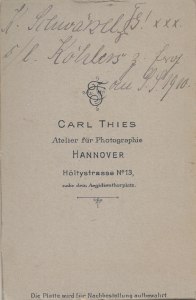
Photographer: Carl Thies. Hannover. Germany

1870’s old smiling man from Algona, Iowa. Burlingame. CDV. Private Collection.
He looks like someone who led a very fulfilling life. There is fire and a zest for life in his piercing eyes old age did not manage to dim. And to complement the effect he still had a headful of thick, snowy white hair.
There is a different kind of true beauty that transcends age and is deeper than the fleeting skin-deep one of youth; this content looking, dignified old man is proof. (I bet though, that he was quite the gentleman in his younger days too!)
I love his generous neck scarf too, the way he tied it in a nice bow.
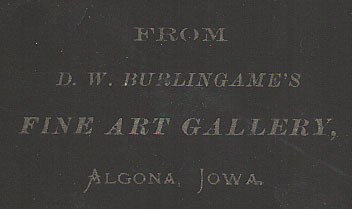
CDV back

1860’s Carte de visite. J.W. Gould. Ohio. Private Collection.
A handsome sitter from the 1860’s with very light blue eyes! Several points to make about this portrait:
I like that the picture was framed within the border lines of this carte de visite.
Also, the way he tied his neck ribbon is interesting.
And he chose to open his waistcoat with the top and bottom still buttoned, like many Civil War soldiers did on the pictures of the era…Was he a veteran in civilian suit? A good chance, the lines and corners of this CDV date this picture to be between 1864 and 1869. The next decade saw the rise of a civilian fashion trend where men wore their coat with the top buttoned but not the bottom. The thought behind it was to show the waistcoat, but I have a theory on it. I think the trend emerged out of respect for soldiers whose uniforms were standard issued and were too small for their frame…For example, the trend of bushy beards became popular with mature Victorians when they wished to imitate the soldiers who fought the Crimean war. I believe people were looking up to those brave boys and adopted their style…so why not the way a coat or waistcoat is buttoned?
Photographer: J.W. Gould. Main Street. Carrollton, Ohio.


 Bowlers And High Collars