Category Archives: RPPCs

I’m with Grouchy!

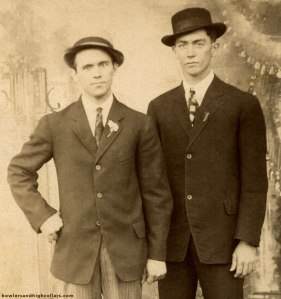
Gentlemen at the fair. RPPC. Private Collection.

Gentlemen at the fair. 1910s-1920s. RPPC. Private Collection.

This picture was part of a lot of RPPCs I got months ago. Sometimes I’ll buy a cheap lot just for a particular picture, but there’s always a few other ones in the midst I’ll like, like this one. The taller gent on the right is wearing a two button coat with matching trousers, and a square patterned tie. His buddy is wearing a flower on the lapel with a light striped pair of pants under his three button coat. This must have been taken during a summer drought; the grass looks brown and their shoes are dusty. I like the pose of the smiling gent on the left, it contrasts with the more serious attitude of his buddy who can’t wait for the picture to be over with. The hand on the hip thing…that’s how everybody’s grandpa used to pose! :)

Gentlemen at the fair. Larger detail.

Larger detail.

RPPC: SOLIO Diamonds. 1903-1920s


I’ll give you one more chance!

Boss and worker RPPC.

Boss and worker RPPC.

This scene looks like a boss berating his young worker, pointing a warning (and inked stained) finger at him. Yet, since this is staged the well dressed chap doesn’t look too mad, unless this is him hiring him and telling him ‘don’t disappoint me!’.

I was outbid on this one, pity! :)


Duo with man in mourning black armband

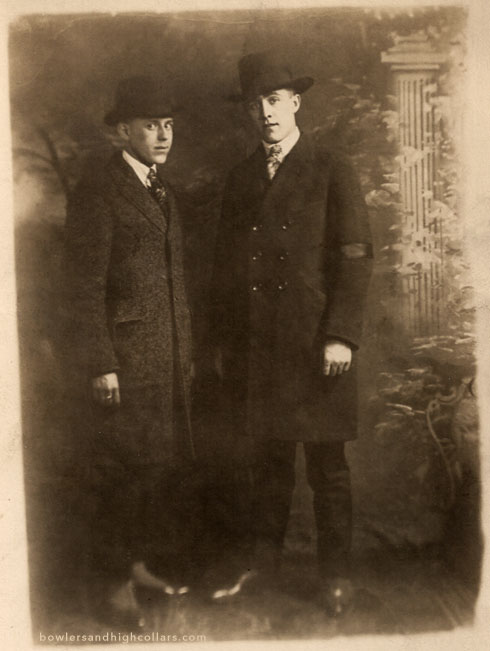
man with mourning black armband. RPPC. Private Collection.

Man with mourning black armband. RPPC. Private Collection.

The black armband meant there was a recent death in the close entourage or household of this gentleman.  The other one may have been wearing it too but it is not visible.

Both men and women mourners wore it on their left arm, and three months seems to have been the accepted length of time to display it. While still worn today by the military and sports teams, we have by and large lost this tradition. The armband let people know the person is grieving, and invited them to treat him or her with compassion and understanding in their difficult time.

Distant family members or friends would dress in gray instead of black.

RPPC: divided back. No stamp box. 1907-1914


Two gentlemen on a grinning Paper Moon

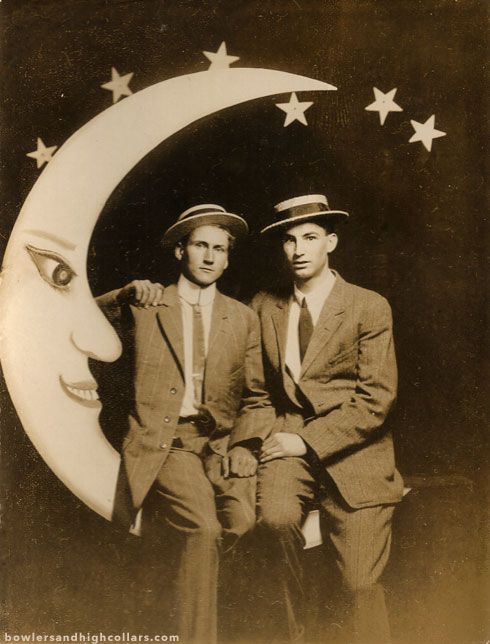
Paper moon duo. RPPC. Private Collection.

Paper moon duo. RPPC. Private Collection.

I’ve been wanting to add a ‘paper moon’ to my collection. The moon is so small these two buddies are almost on top of each other.  And what a toothy grin!

Close up

Close up

Two more examples of gents with paper moons here and here.

I need to find out where this paper moon craze came from. They were found in amusement parks and people loved them.  This Pinterest page is worth checking out.

RPPC: AZO 1904-1918


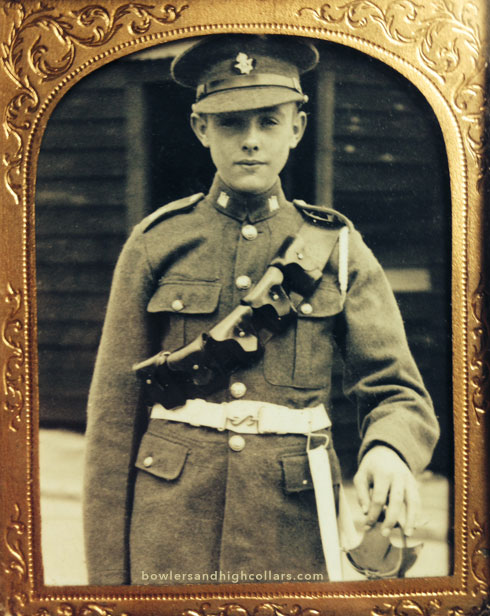
C. Stan, the WWI era British army cadet

Photograph in tintype frame. Private Collection.

Circa 1910 British army cadet. RPPC in tintype case. Private Collection.

This circa 1910 British cadet who can’t be more than 12-13, is proudly posing in his green wool uniform with peaked cap and sword by the side.

I find this photograph quite beautiful yet sad and haunting. This boy went on to fight in the First World War at a very young age, of this there’s no doubt.

I also find interesting that his paper picture was framed in a tintype case.

So I asked myself, “is there a name or note hidden to the back of the picture?” I opened it.

Well, it wasn’t all for nothing (I think I would have kicked myself if I found nothing but something told me). It did reveal a note, the partial name of the boy and that this is a RPPC with the divided back, which dates the picture to around 1907-1914; it fits the era of the uniform.

I think his surname was either Stan or Stanley, and his given name most likely Carl or Charles.
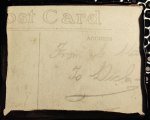
boy-cadet-back-note

From C. Stan to Dick.

Of course I put the case back together and wrote the name in pencil on the outside.

Those cases are fragile but this one had already been meddled with by someone who removed a tintype and replaced it with this RPPC, so I took a chance. I can imagine a family member lovingly doing this or the boy himself to give as a keepsake.

One million British soldiers and allies died during World War I. I set to research some for a match and got sidetracked reading the many individual stories of those who fell. I won’t lie, as an army wife it was particularly emotionally exhaustive, and a partial name isn’t enough to come to a definite conclusion, but I tried. I did find two soldiers by the shared name of Charles Stanley who died in 1917 and 1918 at the same age (19). No one by the name Stan Carl or Charles died during the war is all I can say for sure.

(On Netflix in the U.S you can catch Our World War, a three part BBC docu-series of particularly powerful individual stories of British soldiers who experienced those truly horrible years. If you can get past the choice of music for the soundtrack I highly recommend it. The husband says it is to relate to younger audiences.)