Tag Archives: menswear

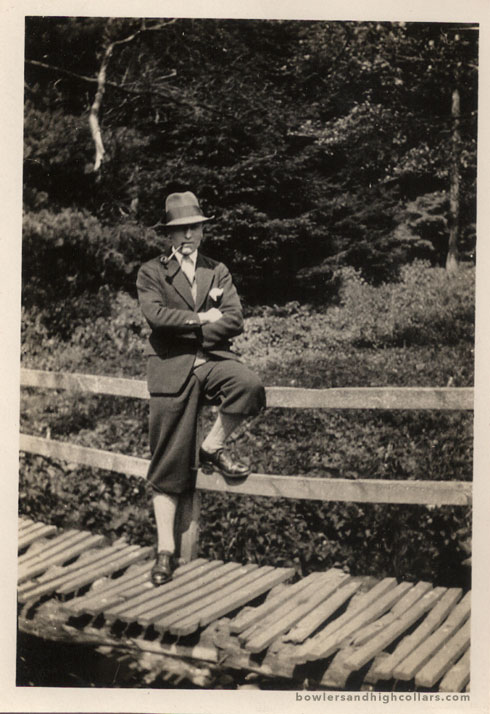
1927 Joseph smoking a long pipe on a precarious bridge

1930s snapshot. Private Collection.

1927 Joseph Bertrand on bridge. Private Collection.

Rule #1: no matter where you are or on what, always look cool.

Joseph looks like he was on a trail bridge desperately in need of repair. Bet he checked the rail first before leaning against it. He’s wearing a panama hat and a suit with ‘plus fours’. The breeches extended 4 inches more below the knee than traditional knickerbockers, hence the name. They were very popular in the twenties as sportswear, especially for golf. Swing dancers adopted them in the 30s and 40s. He’s wearing plain white socks here but ‘plus fours’ popularized a slew of patterned socks like argyles.

This is a small picture, 2″ 1/4 x 3″ 1/4. The man is IDed on the back, the picture dated June 1927.


1890s William Maitland of Brooklyn

Cabinet photo detail. Private Collection.

Will Maitland. Cabinet photo detail. Kempf’s Photo-Art. Private Collection.

This is a large cabinet card measuring 4″ x 8″ with the picture taking the whole front. On the back this fine gentleman is IDed as Will Maitland. He looks proud with a hand on his hip. Larger pictures do make the fabrics and details stand out. Will is wearing what looks like a nice suit with two-toned buttons. His shoes don’t appear to be boots but have no laces either.

Photographer: Kempf’s Photo-Art – Gallery. 185 Myrtle Avenue. Artistic pictures of children a specialty.

Charles L. Kempf was a German born photographer who began operating a Brooklyn studio in at least the late 1870s, the studio was named after himself. He was listed in a Brooklyn business directory as early as 1874. A new business name, “Kempf’s Photographic Art Gallery” was established in the 1890′s and was in business until at least 1905. He is listed in some directories at 185 Myrtle Ave.; 627 Myrtle; and 177 Duffield, Brooklyn, NY (1888) (1889). Later under his business name at: Kempf’s Photo-Art Gallery, 185 Myrtle Ave. and 627 Myrtle Ave., Brooklyn, NY (1890s-1905).

Another card and more info on the photographer: The Cabinet Card Art Gallery


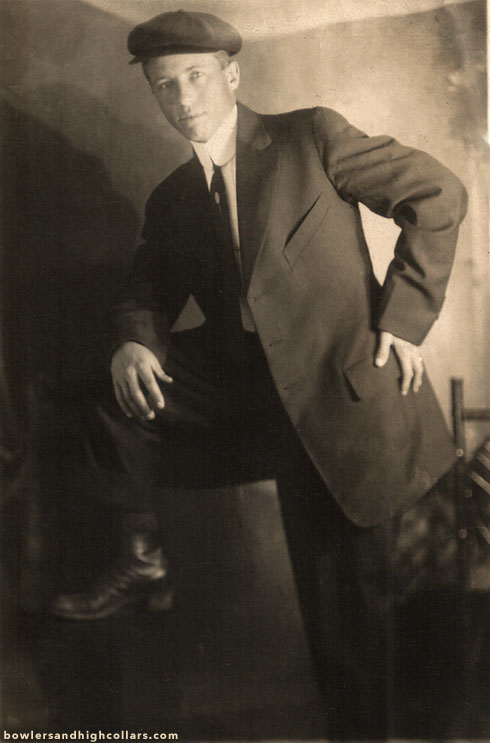
1911 Dean of Northfield, MN

1911 Dean in cap. RPPC. Private Collection.

1911 Dean in cap. RPPC. Private Collection.

I posted this one on tumblr a while ago but I decided to get it, so here it is for this blog.  Dean is posing with a leg up for this snapshot. He sent this picture on October 11, 1911 from Northfield Minnesota. His note is below. I especially like the past part. Is Old Fred a dog?

rppc-dean-back


1910s young man with the upturned collared shirt

RPPC. Private Collection.

RPPC. Private Collection.

He has his collar upturned and it looks like an all-in-one dress shirt + collar. This gent was an early adopter.

And there’s something of a defiant sneer behind this half smile. I’m willing to bet his father of the more conservative, detachable starched collar camp didn’t like that his son wore those shirts.

I can hear the father say “Get this travesty of a shirt off and get a proper collar! What is this world coming to? You look undone!”, to which this young gent replied something like “You and your stuffy old ways! I’ll wear what I want!”

Think I’m exaggerating? :) For us today this may seem like a ridiculous issue, but there was an uproar over the adoption of collared shirts into the mainstream. They were thought to make a man not look like a proper gentleman. Oh, the decaying of society! The British were especially against this trend coming from America. Surprised much? Well, they lost this battle.

rppc-loup-city-gent-2

Photographer: Elsner Studio. Loup City. Nebraska

RPPC: AZO 1904-1918


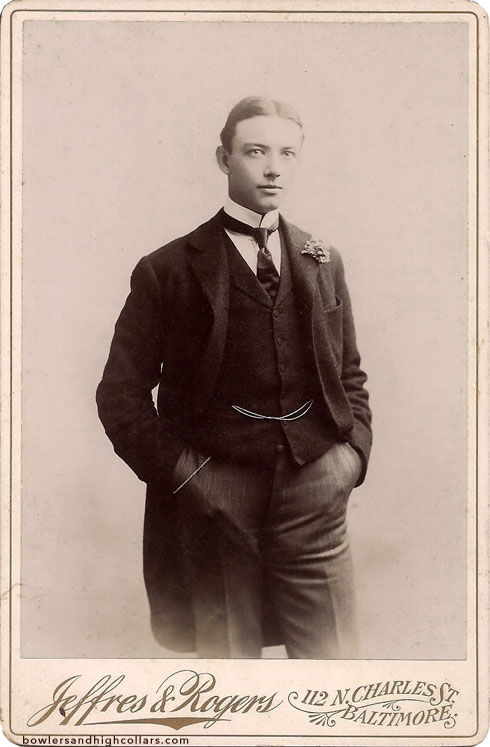
Victorian gentleman Walton Stauf of Baltimore

1880s Walton Stauf. Cabinet card. Private Collection.

1880s-1890s Walton Stauf. Cabinet card. Private Collection.

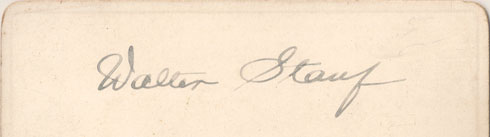
back of card signature.

back of card signature.

Mr. Cool is posing in a fine long tail coat with matching waistcoat, and with his hands in pockets. He doubled up his fob chain, made a hole into the waistcoat pocket, passed it through and extended it all the way to his pants’ pocket -that’s one very long chain. I can see this gent thinking up something like this after losing an expensive pocket watch and then wanting the replacement to be more secure.

Well, we know he was right-handed. :)

And from the suit with the creased pants that he wasn’t hard up for money, but I couldn’t find anything about him. Pity!

There were/are very few Staufs in the U.S. A Henrietta Stauf emigrated from Germany to Maryland passing through Canada in 1858. She likely was related to Walton.

Photographer: Jeffres & Rogers. 112 N. Charles St. Baltimore. Maryland. The back is blank.